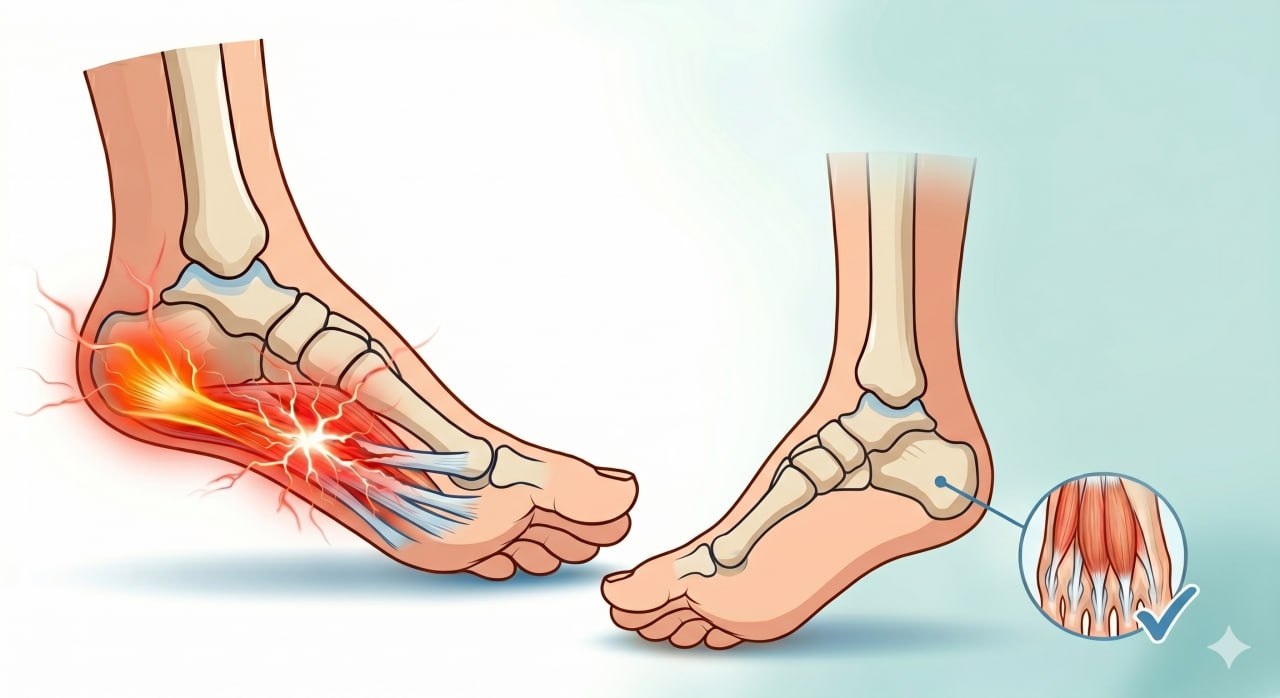
Plantar Fasciitis — more than just a heel problem.
That sharp, stabbing pain in the heel the moment your foot hits the floor. It eases, then returns. You've tried rest, ice, stretching, insoles. It keeps coming back. That's usually a sign something in the way you're loading your foot hasn't been addressed.
Aching arch or heel after long periods on your feet
Symptoms that improve with rest but return with activity
Pain that keeps coming back despite treatment
Understanding the problem
What's Actually Going On
The plantar fascia is a thick band of tissue that runs along the bottom of your foot, connecting your heel to your toes. When it becomes irritated and inflamed — usually from repeated overloading because a small muscle called your Flexor Digitorum Brevis needs some help — you get plantar fasciitis.
But the plantar fascia doesn't become overloaded for no reason. The way your foot loads as it hits the ground, moves through its stride, and pushes off determines how much strain that tissue takes with every step. If the foot isn't moving well, if something in the movement pattern is missing or restricted, the plantar fascia ends up absorbing forces it was never designed to manage alone.
Flat feet and high arches are often mentioned as causes, but foot type matters less than how the foot actually functions. A foot that moves well is far less likely to develop plantar fasciitis than one that has lost control of how it loads. And that loss of control rarely starts in the foot — it's usually connected to what's happening further up the chain, in the ankle, the hip, and the way the whole body moves.
The approach
How I Work With It
01
How you're loading through your gait cycle
Where the weight is going, whether the foot is getting the movement it needs at each stage of the stride, or whether it's restricted. Perhaps the other leg is not as strong as we would like and forcing the plantar fascia to compensate on the affected side.
02
What your hip is doing
When rotation is reduced or restricted at the hip, it directly affects how the foot loads. It's also a timing issue — whether the foot is landing in the right sequence, and whether it has enough time within each stride to move the way it needs to. When one part of that chain is out of sync, the plantar fascia ends up taking more load than it should.
03
Foot intrinsic strength
The small muscles inside the foot play a crucial role in how it absorbs and distributes load. When they're weak, the plantar fascia picks up the slack. Strengthening them — in the right way, in the right order — takes the pressure off the tissue and gives the foot the support it needs from within.
What to expect
What a Session Looks Like
Sessions are hands-on and practical. We'll look at how you move, how your foot loads, and where the restrictions are in the chain. You'll leave with a clear understanding of what's been driving your symptoms — and a specific exercise programme, fully videoed, that takes around 20 minutes a day at home. No gym required. The goal isn't just to settle the pain. It's to restore the movement patterns that stop it coming back.
"Rest and stretching can offer relief. But if the underlying loading pattern hasn't been addressed, it will keep coming back — and that's what this work changes."
In most cases, the way your foot and body move is driving the problem. It's worth exploring whether that's true for you.
Common questions
Frequently Asked Questions
Rest and stretching can offer some short-term relief. But if the underlying reason the tissue is being overloaded hasn't been addressed, the symptoms will keep coming back the moment you return to your normal routine. What the foot actually needs is better movement and the right strength — and that's what addresses the cause rather than the symptom.
Yes — and this is one of the things most people haven't been told. When rotation is missing at the hip, it directly affects how the foot loads with every step. Think of it like a chain of events that needs to happen in the right order. When one part of that chain is off, the plantar fascia ends up taking more load than it was designed to handle.
It's never too late. Many of the clients I work with have been dealing with plantar fasciitis for months or years before they come to see me. The longer it's been there, the more entrenched the loading pattern tends to be — but the body responds well when you give it the right input.
Not necessarily. For many people, modifying rather than stopping activity is absolutely possible — and staying active is often beneficial. We'll work out what adjustments make sense for you. The goal is always to keep you moving as much as possible while the underlying patterns are being restored.
Two things matter most. First, a wide toe box — the foot needs room for the toes to splay. Second, a stable sole that supports the foot properly as it contacts the ground. Over-cushioned shoes can feel appealing when you're in pain, but if the foam doesn't support the foot as it moves, it can allow the foot to collapse in ways that add to the problem.
Ready to start?
Take the first step toward a foot that works the way it's supposed to.
Based in Brighton · Working with clients across the surrounding area