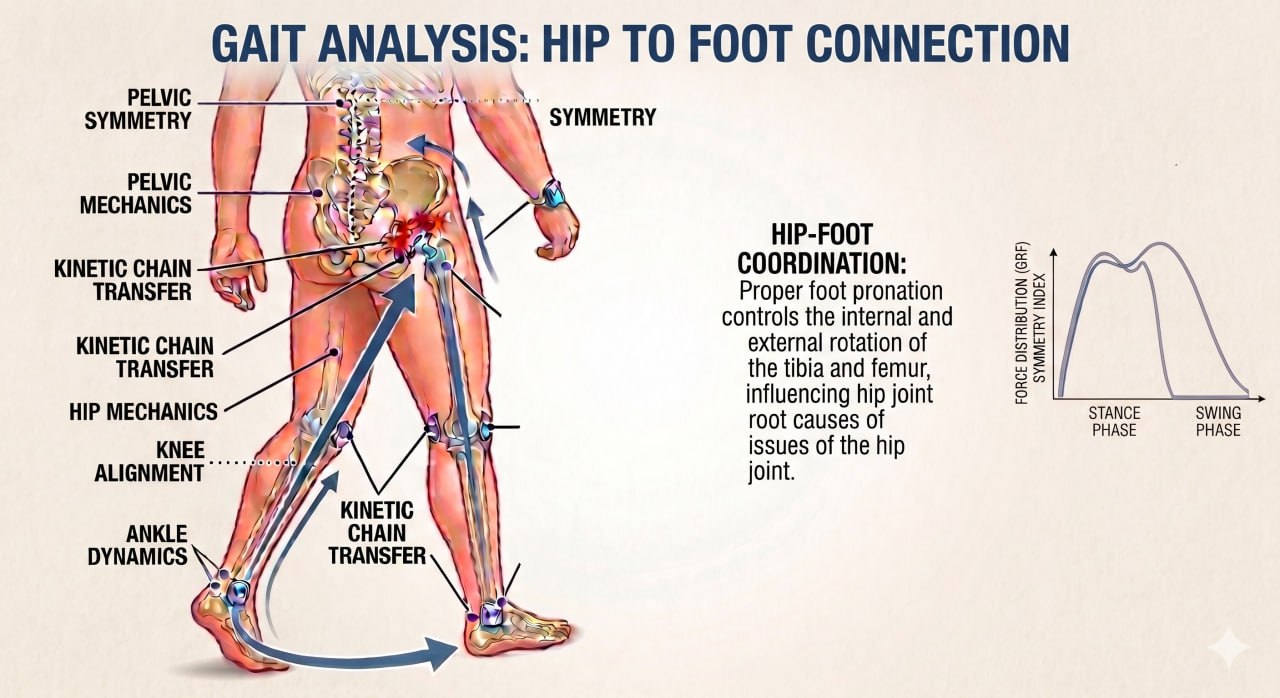
Not just the way you walk — but how you manage load. How force moves through your system with every step. Where your body is compensating, holding back, or working harder than it needs to. That understanding is what makes the difference between treating symptoms and actually resolving them.
At The Body Mechanic, the gait analysis forms the foundation of every Missing Piece Assessment. It's not about labelling you — telling you that you have a twisted pelvis or that you're out of alignment. It's about finding what's missing and putting it back.
The approach is built around Gary Ward's AIM method — Anatomy in Motion — which is built around one central idea: find what's missing in the movement system and put it back. If you tend to rotate more to one side than the other, for example, the work is simply about restoring a little rotation in the opposite direction.
The technology
The Force Plate
Central to the assessment is a force plate linked directly to my laptop, giving a detailed picture of what's happening from the inside out — information that simply isn't visible to the naked eye.
Pressure distribution
Where you're holding pressure through your feet — more detail than any visual assessment can offer
Load balance
Whether you're carrying more load on one side than the other, or rotated slightly in one direction
Toe gripping
Whether you're gripping through your toes — something many people do without realising as the body tries to create stability elsewhere
Two readings
One standing still and one walking over the plate — together building a picture that goes beyond visual assessment alone
What Happens Next
01
Walking assessment
I observe you walking and look at how you move through the different stages of your stride — where the body is missing movement or managing load in a way that isn't serving it.
02
Detailed analysis
Outside of the appointment I break down the findings in detail, identifying exactly where balance needs to be restored and what the body needs to move better.
03
Your videoed programme
You receive a specific exercise programme, fully videoed, built entirely around what your assessment revealed. Around 20 minutes a day at home. No gym required.
What to expect
What a Session Looks Like
The assessment is thorough and hands-on. The force plate readings are taken during the session and I observe you walking as part of the process. The detailed breakdown and exercise programme are prepared outside of the appointment so that everything is specific to you — fully videoed and ready to start straight away.
See it for yourself
Watch: What is the Missing Piece Assessment?
Lou explains exactly what's involved in the assessment — and why it finds answers that other approaches miss.
"The gait analysis is the key to understanding what your body has been missing — not just the way you walk, but how you manage load."
People dealing with foot pain, knee pain, hip pain, back pain, or a combination of things that nobody has been able to join up yet
Those who come because something doesn't feel quite right but can't put their finger on what
Anyone who wants to understand how their body moves before problems develop
The Missing Piece Assessment is the starting point for almost everyone who comes to see me
Some people come in with a clear longstanding complaint. Others come simply because they want to understand how their body moves. The assessment works for all of these.
Common questions
Frequently Asked Questions
They're the same thing. The gait analysis is the foundation of every Missing Piece Assessment — the force plate, the walking assessment, and the movement analysis all form part of that process. I use the name Missing Piece Assessment because that's really what it is — finding the piece that's been missing from the picture.
Not at all. Some people come in with a clear longstanding complaint and want to understand what's driving it. Others come because something doesn't feel quite right but they can't put their finger on what. Some come simply because they want to understand how their body moves before problems develop. The assessment works for all of these.
It gives a detailed read of how you're distributing load through your feet — both standing still and walking. It shows where you're holding pressure, whether there's more load on one side, whether you're rotated slightly, and whether you're gripping through your toes. Together the two readings build a picture that simply isn't available from visual assessment alone.
No. The assessment isn't about labelling what's wrong with you — it's about understanding how your whole system is managing load and where it needs support to move more freely. The findings lead directly to a specific exercise programme built around what your body needs.
The force plate readings are taken during the session and I observe you walking as part of the process. The detailed breakdown and exercise programme are prepared outside of the appointment so that everything is specific to you — fully videoed and ready to start straight away.
Ready to start?
Find out what your body has been trying to tell you.
Based in Brighton · Working with clients across the surrounding area