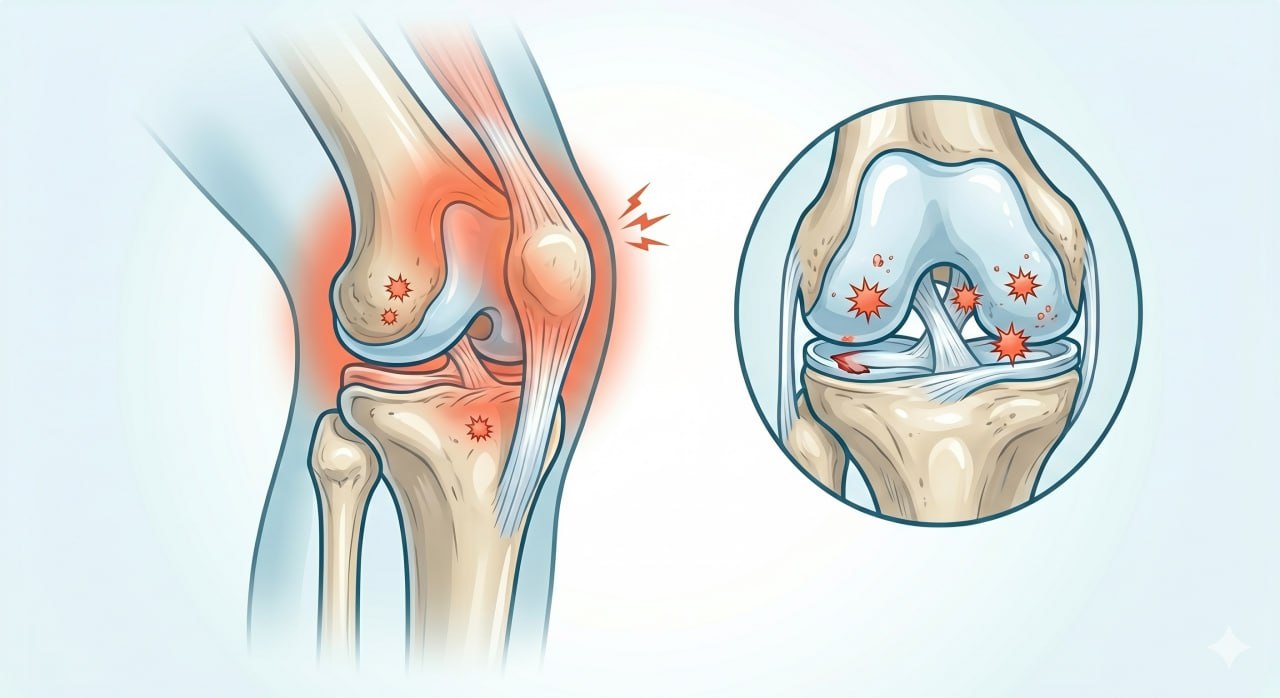
The instinct, when your knee hurts, is to think the knee is the problem. But in most cases — when there hasn't been a direct trauma — the knee isn't where the problem starts. It's where it shows up. I very rarely start at the knee. I start by looking at what's happening around it.
Knee that collapses inward when squatting or lunging
Aching after sitting for long periods
Knee pain that returns despite physio or strengthening
Discomfort behind or around the kneecap
Understanding the problem
What's Actually Going On
When we talk about knee pain, the quadriceps — the muscles at the front of the thigh — tend to get all the attention. But rehabbing a knee means looking at the whole system, not just what's happening at the front of the leg, because what's happening behind the leg matters just as much. The hip matters too, as it has a direct effect on how the knee moves and how you are loading the knee.
When the system isn't working as well as it could, people tend to drive energy through the knee joint rather than around it. Instead of the knee rotating as it should, it drops into more of an angular movement — and you may have noticed this yourself, with the knee collapsing inward when you squat, walk downstairs, or lunge.
The body is always looking for a way to keep you moving, but the compensation it creates can start to load other areas and pain begins to appear in places that seem completely unrelated. Pain is just a flag — your body telling you that something needs attention, not necessarily at the place where it hurts, but somewhere in the system.
The approach
How I Work With It
01
Below the knee — foot and ankle
The foot and ankle are the foundation of how load travels up into the knee. A history of ankle sprains is often directly connected to knee pain that develops later, even if the ankle feels perfectly fine now. We look carefully at what's happening from the ground up.
02
At the knee — front and back
We look at the knee itself from front and back — not just the quadriceps but everything behind the leg that plays a role in how the knee functions under load. Stairs are one of the most revealing movements for knee pain because they require the knee to load under full body weight through a significant range.
03
Above the knee — the hip
The goal is always to find what the system is missing and put it back, so the knee stops being asked to do more than it was designed for. Once the movement is right, the strength work sticks — and that's the difference between results that last and pain that keeps coming back.
What to expect
What a Session Looks Like
Sessions are hands-on and practical. You'll leave with a clear understanding of what's been driving your knee pain alongside a specific exercise programme, fully videoed, that takes around 20 minutes a day at home. No gym required.
"Strengthening has its place — but it's rarely the whole answer. Getting the movement right first is what makes the strength work stick."
If you've tried everything and it keeps coming back, you're in the right place
People who want to get back to the gym, back to sport, or simply walk up and down stairs without thinking about it
Those who've had physio that helped for a while but where the pain keeps returning
Anyone whose knee collapses inward when squatting or lunging
Pain is just a flag telling you something needs attention — and once that something is addressed, there's no reason you can't get back to full activity.
Common questions
Frequently Asked Questions
Strengthening has its place, but it's rarely the whole answer and it's almost never where I start. The knee is often where the pain shows up, not where the problem starts, and building strength on top of a movement pattern that hasn't been addressed often means the pain settles temporarily but keeps coming back.
Stairs are one of the most revealing movements for knee pain because they require the knee to load under full body weight through a significant range. When the movement pattern isn't quite right — when the knee is dropping inward, when the hip isn't controlling rotation properly, or when something below isn't providing the right foundation — stairs make that visible in a way that walking on a flat surface doesn't.
Yes — and this is something most people haven't considered. The foot and ankle are the foundation of how load travels up into the knee, and a history of ankle sprains is often directly connected to knee pain that develops later, even if the ankle feels perfectly fine now.
This usually means the underlying pattern hasn't been fully addressed. If the work doesn't extend to the whole chain — what the foot is doing, how the hip is loading, what the body has been compensating around — the pain will return when you go back to your normal activities.
Absolutely. Whether that's running, the gym, sport, or simply being able to walk up and down stairs without thinking about it, the goal is always to restore the movement patterns that allow you to do those things without the knee being overloaded.
Ready to start?
Find out what your body has been trying to tell you.
Based in Brighton · Working with clients across the surrounding area