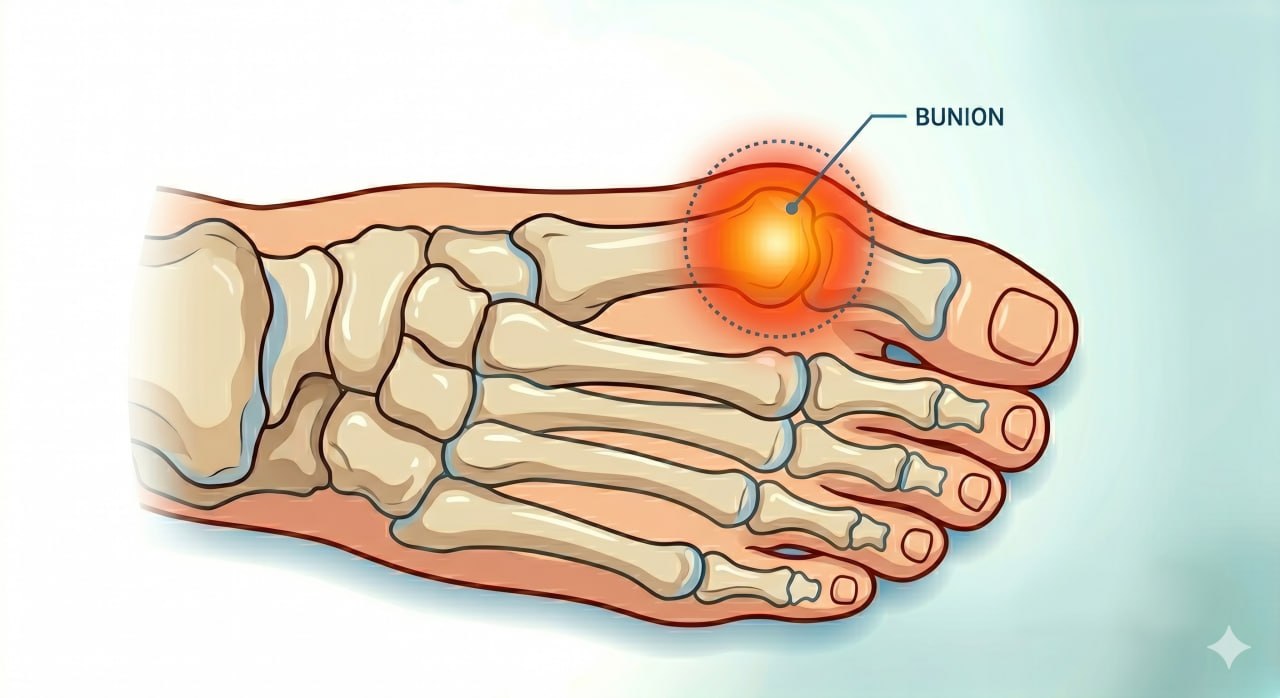
Have you been told that your bunions are hereditary? The answer is — perhaps. Genetics can play a role. But for many people, the real driver is something that can actually be addressed: poor foot mechanics and the way load is distributed through the foot.
A bunion develops when the forefoot takes more load than it should. When the foot isn't moving well, the forefoot ends up absorbing forces that should be distributed across the whole foot and body. Over time, that excess load starts to change the bony structure of the foot. The big toe joint shifts, the deviation becomes visible, and the joint starts to feel stiff and uncomfortable.
Footwear plays a part too. Shoes with a narrow toe box squeeze the forefoot, restrict natural movement, and push the toes into positions they were never designed to hold. It's also worth knowing that on the opposite side of the foot, around the outside of the little toe, you may develop what's known as a tailor's bunion — which forms for similar reasons and can become just as painful. Both can be worked with using the same approach.
A Note on Surgery
Surgery is sometimes presented as the straightforward solution to a bunion — but it isn't always the easy answer. If the underlying movement pattern that caused the bunion hasn't been addressed, surgery can create new problems. People often find that after bunion surgery they start experiencing pain elsewhere — in the knee, the hip, or the lower back — as the body compensates for a joint that can no longer move freely. A whole-body movement assessment before committing to surgery is always worth doing.
The approach
How I Work With It
01
Restoring movement through the big toe joint
Using Gary Ward's AIM method — Anatomy in Motion — we work to restore what's missing in the movement system. For bunions that means restoring movement through the big toe joint and getting the foot functioning as it was designed to.
02
Building strength through the inside of the foot
Introducing exercises to build strength through the inside of the foot and introducing tools like toe spacers to help the toes function more naturally. Toe spacers help create space between the toes, allow the forefoot to spread more naturally, and reduce the compression that contributes to bunion discomfort.
03
Footwear guidance
If movement through the big toe joint is restricted, we can also look at footwear that helps restore that movement. A wide toe box is essential — giving the forefoot the room it needs to function naturally makes an immediate difference.
What to expect
What a Session Looks Like
Sessions are hands-on and practical. We'll look at how you move, how you load, and where the restrictions are. You'll leave with a specific exercise programme, fully videoed, that takes around 20 minutes a day to complete at home. No gym required.
"A whole-body movement assessment before committing to surgery is always worth doing. The loading pattern that created the problem may still be there afterwards."
If you've tried everything and it keeps coming back
People who are on their feet all day and want to move without discomfort
Those who want to get back to exercise without the bunion holding them back
Anyone who simply wants to walk the dog without it hurting
People considering surgery who want to explore a conservative approach first
If you've already had surgery and the symptoms have returned, or you're experiencing new discomfort in your knee, hip, or back since the operation, it's likely that the underlying movement pattern hasn't been fully addressed. A whole-body movement assessment can be really valuable post-surgery.
Common questions
Frequently Asked Questions
Surgery is often presented as the only real solution — but it isn't always the right first step. The goal of the work I do isn't to reverse the bony change overnight. It's to improve how the foot moves, reduce the load on the joint, ease the stiffness and discomfort, and where possible slow or halt the progression. Many people find significant relief through this work without needing to go down the surgical route.
Genetics can play a role, but hereditary doesn't mean inevitable or untreatable. What we can address is the loading mechanics that are driving the progression. Even if you have a genetic predisposition, improving how your foot loads and moves can make a real difference.
Because the body is one connected system. When the big toe joint is stiff or restricted, the body finds another way to move — and that compensation travels upward. The knee has to track differently. The hip works harder. The back picks up load it shouldn't be carrying. Once movement is restored through the big toe joint, that whole compensation pattern begins to unwind.
Toe spacers help create space between the toes, allow the forefoot to spread more naturally, and reduce the compression that contributes to bunion discomfort. They won't fix a bunion on their own, but as part of a wider programme of movement restoration and strength work, they can be a useful addition.
If you've had surgery and the symptoms have returned, or you're experiencing new discomfort in your knee, hip, or back since the operation, it's likely that the underlying movement pattern hasn't been fully addressed. A whole-body movement assessment can be really valuable post-surgery.
Ready to start?
Find out what your foot has been trying to tell you.
Based in Brighton · Working with clients across the surrounding area